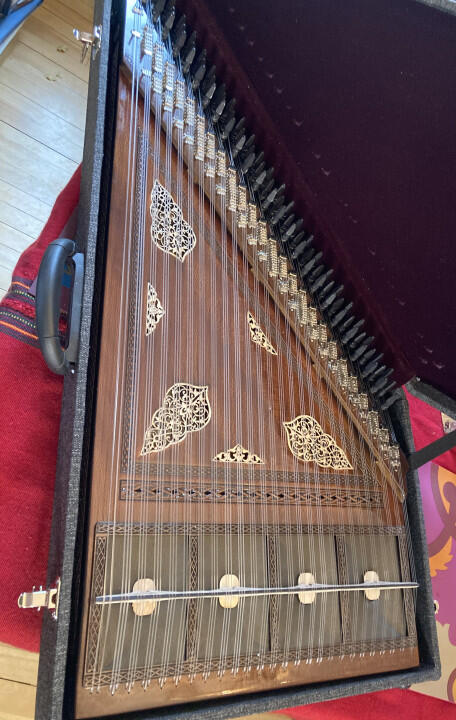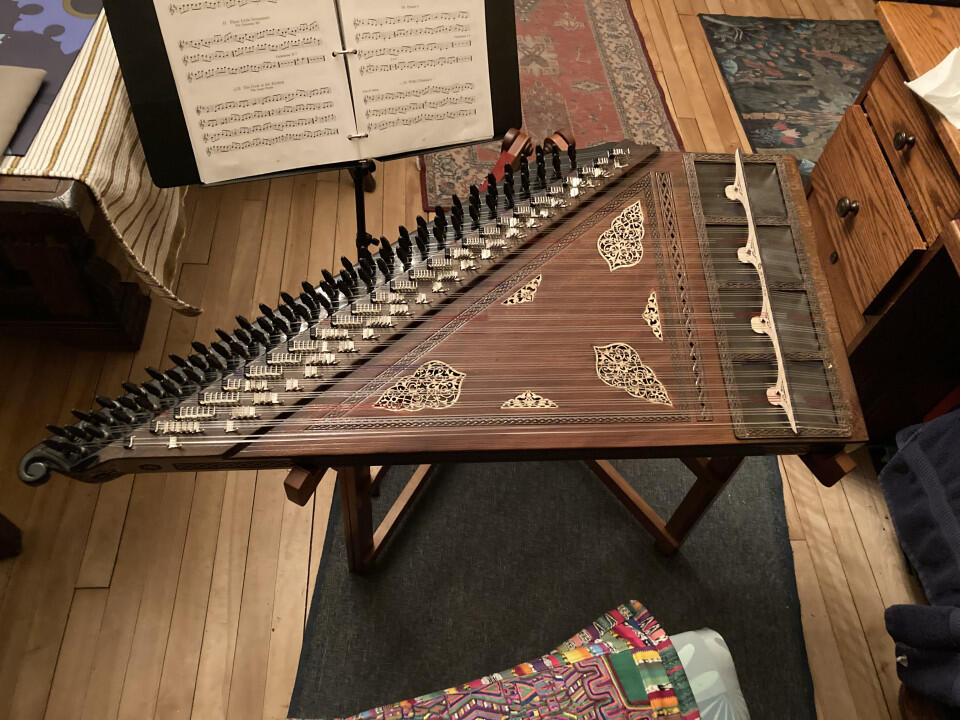
プロフェッショナル・トルコ・カーヌーン MK-123は、Mustafa Sağlamのアンカラ工房で製作されたトルコ式カーヌーンです。プラタナス材(チナール)のボディ、黒檀のペグ、アルパカ製マンダル、PVF弦を備え、トルコの標準的なA-A'マカーム音階に調律されています。製作者も、工房での製作時間も、品質基準も、姉妹モデルのMK-404とまったく同じです。両者の違いはボディ材のみで、それぞれに異なる色合いと外観の個性があります。
どちらも同じアンカラの工房で、同じルシアー(Mustafa Sağlam)が製作し、同じ製作基準を満たし、価格も同一です。品質の上下はありません。意味のある違いは木材だけです。MK-123はプラタナス材/チナール(より軽く淡い色で、クラシックなトルコ式カーヌーンの外観に近い)、MK-404はウォールナットにスプルースの響板(より温かく深みのある音色)を採用しています。お好みの木材をお選びください。どちらもトルコのマカーム・レパートリーに等しく適しています。
| 製作者 | Mustafa Sağlam — トルコ・アンカラ |
|---|---|
| チューニング | トルコ式 A-A'(低音A〜高音E) |
| マンダル・システム | コースごとに24個(アルパカ) |
| 響板 | プラタナス材(チナール) |
| チューニングペグ | 黒檀 |
| 弦 | PVFナイロン |
| 付属品 | ハードケース、交換用弦、マンダル調整用キー、フィンガーピック |
| 原産国 | トルコ・アンカラ |
| モデル | 価格 | ボディ材 | 製作者 |
|---|---|---|---|
| MK-123 | $1,299 | プラタナス材(チナール) | Mustafa Sağlam · アンカラ |
| MK-404 | $1,299 | ウォールナット+スプルース | Mustafa Sağlam · アンカラ |
| MKA-4 | $1,299 | プラタナス材の表板 | Mustafa Sağlam · アンカラ |
| MKE-5 | $1,299 | プラタナス材の表板 | Mustafa Sağlam · アンカラ |
| MSK-4 | $3,999 | プレミアム仕様 | Miras · イスタンブール |
どちらもMustafa Sağlam(アンカラ)の製作で、品質は同じ、価格も同じ$1,299です。素材上の違いは木材のみで、MK-123はプラタナス材(より軽い)、MK-404はウォールナット+スプルース(より温かく深い音色)です。色の好みでお選びください。どちらかが「優れている」わけではありません。
Mustafa Sağlamの工房(トルコ・アンカラ)で製作されています。イスタンブール/ユスキュダルの当社工房で検品と調整を行ったうえで、世界中へ発送します。
自信を持って演奏できるようになるには、毎日の練習で1〜2年が目安です。マンダル・システムは音高以上の複雑さを加えます。曲の途中でも、マカームが移り変わるたびに音程の位置を切り替えます。
はい。アンカラから当社のイスタンブールの調整工房へ送って検品した後、二重壁の特注木箱にフォーム緩衝材を詰め、全額保険付きのDHL/FedEx Expressで発送します。EU/米国へは5〜9営業日です。
たまに弾く場合:6〜12か月。毎日の練習・演奏:3〜6か月。音のバランスを保つため、弦は一本ずつではなくコース単位で交換してください。
注文品はいつ届きますか?
送料無料配送の場合、世界各国へのお届けは3-5週間です。
DHL配送の場合、世界各国へのお届けは2-4日です。
Sala Muzikは海外発送に対応していますか?
現在、世界中どこへでも発送しております。
Extremely pleased with the quality, the beautiful design and especially the sound of this Kanun. Shipping was timely and well packaged. Was very impressed with how well it stays in tune, even after long practice sessions and with variations in weather. The hard case is very stable, yet quite easy to carry.
My highest compliments and deep gratitude to Sala Music! Teşekkür ederim!
My first Kanun. I don’t have much experience to compare but the more time I spend the more fun I get. Inlays seems to be set strategically and very helpful mapping the instrument. I figured imaginary lines between inlays which makes it easy to locate harmonics. I am not sure whether it was random or ingenious of the maker, but I am leaning towards latter. Had it for a few weeks and tuning hasn’t set in yet. May be this is natural to this instrument since it has many moving organic parts. Once tuned it holds pretty well during fun session. I practice about 3-4 times a week. I need to spend 15-20 minutes each time to tune. It loses a few cents on almost all strings. Sometimes I tune using mandals to get there faster if all three strings lost value to a closer or similar degree. So far I am happy with the purchase. It arrived fast and it was packed very well.
I'm satisfied with the good quality of this beautiful Kanun. I received it in my country after 5 days only from payment and without extra taxes. I never played Turkish Kanun (I used to play on Arabic Kanun) and I think this is a good one in term of quality and price. It's also with lightweight and easy to carry as arabic ones are heavy! Thank you SALA MUZIK :)
This is my first time buying a Kanun and it has a really great sound. Thanks to Mustafa Saglam who created an instrument that gives pleasure when you play and here it. I even received some extra strings for the Kanun. If you are interested in Turkish Makams, Classical Turkish Music and more, you can definitely give this instrument a try! If this is the first time you are seeing this instrument, try listening Goksel Baktagir and Aytac Dogan.
This is a beautiful instrument, and I've been looking forward to learning to play it. I bought it so I could play some microtonal tunings by using the mandals, but that concept only works if the tuning is stable. Due to a combination of peg slippage and the stretching of the new nylon strings, a few strings are out of tune again even before I finish tuning. A friend advised me to put chalk on the pegs that totally came loose during tuning, and I've been doing that. It does help. I don't know whether the tuning will become more stable as the instrument settles down, or whether there's something odd about this particular qanun. Tuning before you play is of course necessary for any qanun! It's what musicians do.As a point of reference, the Korg chromatic tuner is worse than useless with a rapidly decaying plucked string. I'm using a sustained synthesizer tone for reference while tuning, a pure sawtooth wave. I know what strings sound like when they're in tune. I don't mind a little beating between two strings in a course. That adds to the tone quality of the qanun. But what I've heard so far, in the first few days, is more than "a little beating."